Knowledge base · Recommended modern baseline
Recommended Modern Baseline: Build a PV System That Works Together
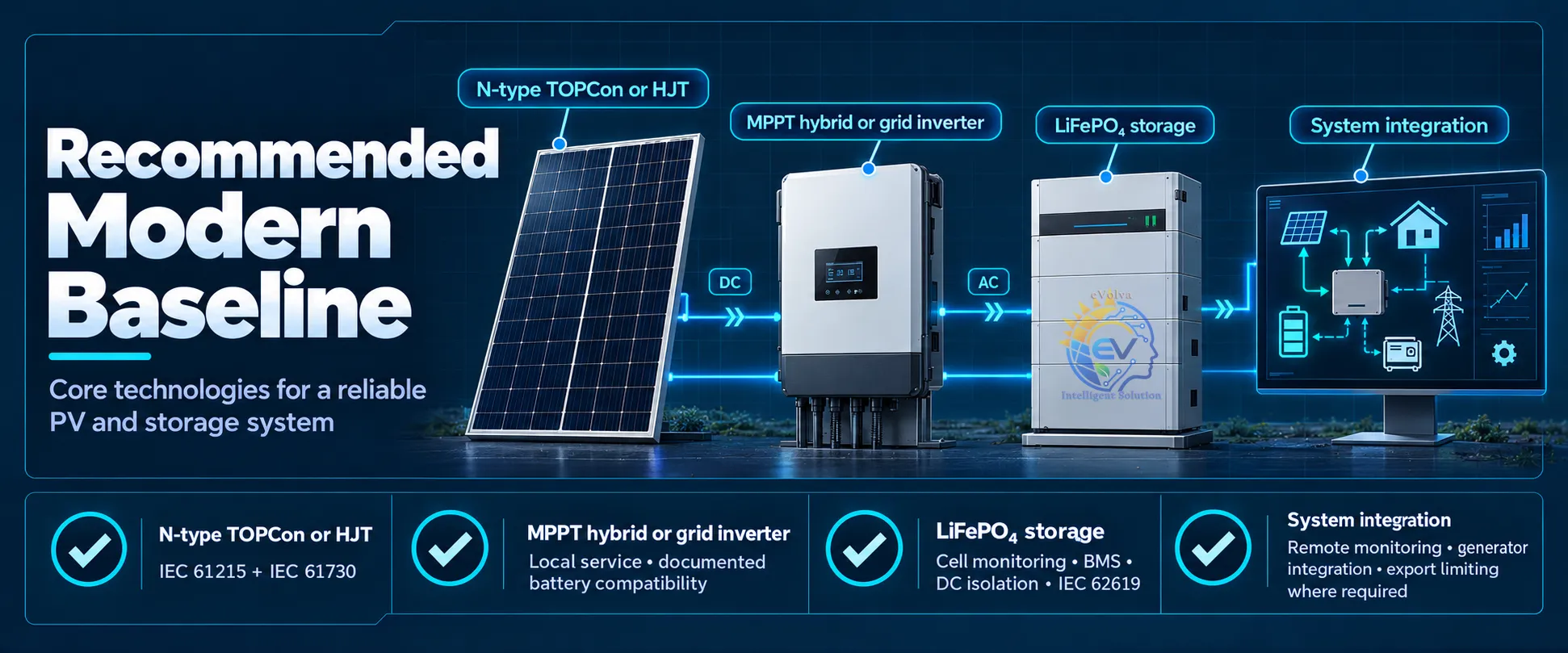
Four technology choices can create a strong starting point—but the real baseline is compatibility, evidence and service.
At the first design review, the project owner had a stack of impressive brochures on the table. One module had a high wattage. One inverter promised hybrid operation. A battery supplier quoted a large kilowatt-hour figure. The question was simple: “Which one is the modern choice?”
The designer began with a different question: “What must the system do here?”
A solar installation may serve daytime loads, reduce grid purchases, provide backup during outages, or combine those goals. The answer affects the module layout, inverter type, battery size and control settings. A modern baseline is therefore a starting point for a site-specific design—not a fixed equipment list that fits every roof, business or factory.
Start with the PV modules
For the module shortlist, the team considered N-type TOPCon or HJT products. Those names helped narrow the search, but they did not replace checking the exact model and its documents.
The team requested evidence for the module’s IEC 61215 design qualification and IEC 61730 safety qualification. IEC 61215 addresses design qualification and type approval for terrestrial PV modules, while IEC 61730 covers module construction and safety testing. These standards help frame the evidence review; they do not, by themselves, prove that a module suits a particular site or guarantee a specific service life. [1][2][3]
Next, the designer matched the module’s electrical and physical details to the planned array and structure: open-circuit voltage, current, temperature behavior, dimensions, connectors, permitted clamp zones and mounting instructions. These checks help prevent a “modern” module from becoming a poor fit for the inverter input or the mounting system.
Choose the inverter for the job
With the intended system mode clear, the owner and designer compared MPPT hybrid and grid inverter options. A hybrid model may suit a project that includes storage or backup operation. A grid inverter may suit a PV-only system connected to the grid. The right choice depends on the loads, supply arrangement, export rules and backup needs.
The team checked the inverter’s MPPT input range and limits, phase arrangement, continuous output, backup capability where needed, and the manufacturer’s installation instructions. Local service support also mattered: a system is easier to maintain when qualified help, replacement parts and clear warranty processes are available.
Because the project might include a battery, the designer asked for written compatibility information for the exact inverter and battery models. “Battery ready” on a brochure was not enough. The equipment documents needed to establish the approved pairing and explain the required communications, operating limits and configuration.
Add storage when the use case calls for it
The owner wanted some evening backup, so the team evaluated LiFePO₄ storage. The selection discussion went beyond the battery’s headline capacity. They compared usable energy in kWh, continuous and peak power in kW, the expected loads, operating conditions and the backup duration the system was meant to provide.
The battery package also needed cell monitoring, a battery management system (BMS), suitable DC isolation and clear installation instructions. For safety evidence, the team requested documentation showing the exact battery product’s scope against IEC 62619. IEC 62619 specifies safety requirements and tests for secondary lithium cells and batteries used in industrial applications, including stationary applications. [4]
The inverter and battery had to operate as a documented pair. The team recorded model numbers, settings and any communications requirements so the installer would not have to guess during commissioning.
Connect the system to the site
The final part of the baseline was the control layer. Remote monitoring would let the owner and service team review production, battery status and alarms. Generator integration would be included only if the site needed it and the selected equipment supported the intended arrangement. Export limiting would be configured and verified where required by the utility or project rules.
These features work only when the equipment, sensors, wiring and settings agree. The design therefore documented how each operating mode should behave and how the installer would verify it.
Turn the baseline into a procurement checklist
Before ordering, the project team put the selection into a short equipment schedule. It named the exact module, inverter and battery models; linked their datasheets and standards evidence; recorded compatibility requirements; and listed the site checks still to be completed.
| Baseline item | What to document |
|---|---|
| PV modules | N-type TOPCon or HJT option; exact model; IEC 61215 and IEC 61730 evidence; electrical and mounting data |
| Inverter | MPPT hybrid or grid type; PV input and AC limits; local service; documented battery pairing if storage is planned |
| Battery | LiFePO₄ product; usable energy and power; cell monitoring; BMS; DC isolation; IEC 62619 evidence |
| System integration | Monitoring method; generator interface if needed; export-limit equipment and settings where required |
At handover, the installer would verify the configured equipment, operating modes and monitoring signals against the approved design and manufacturer instructions. The owner would receive the equipment records and know who to contact for local service.
The review ended with a clearer answer than “buy the newest technology.” N-type TOPCon or HJT modules, an appropriately selected MPPT inverter, LiFePO₄ storage where needed, and well-planned monitoring and controls make a useful modern baseline. The stronger design is the one whose exact products fit together, have verifiable documentation and can be supported at the site.
Standards references
- IEC 61215-1:2021 — Terrestrial photovoltaic modules: design qualification and type approval
- IEC 61730-1:2023 — Photovoltaic module safety qualification: construction requirements
- IEC 61730-2:2023 — Photovoltaic module safety qualification: testing requirements
- IEC 62619:2022 — Safety requirements for secondary lithium cells and batteries for industrial applications
Confirm the applicable standards edition, certification scope and local requirements for the exact products and project before procurement.